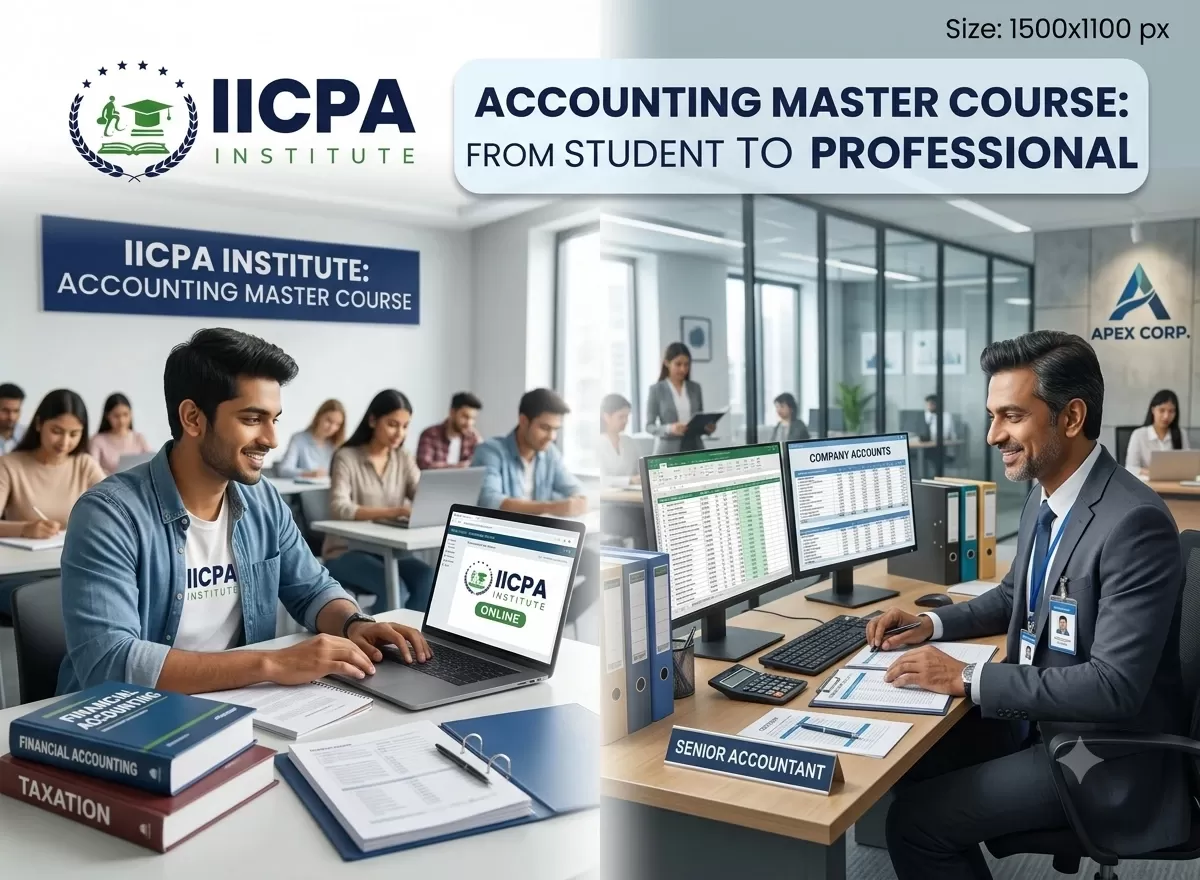
In today’s competitive job market, having only a degree is often not enough to get a good accounting job. Companies need accountants who have practical knowledge of accounting, Tally, GST, taxation, payroll, and financial reporting. If you want to build a successful career in accounting, the Accounting Master Course can be a valuable choice.
The Accounting Master Course is designed to provide practical knowledge of Tally and Complete Accounting Course. After completing this course, students can develop the skills required to work as an accountant in different types of companies, businesses, offices, and organizations.
What is an Accounting Master Course?
The Accounting Master Course is a practical accounting training program that covers the important skills required for modern accounting jobs. It combines accounting concepts with software-based practical training.
Students learn how business transactions are recorded, how accounts are maintained, how financial statements are prepared, and how statutory compliances are handled.
The course generally focuses on areas such as:
- Basic and advanced accounting
- Tally software
- GST accounting and returns
- Income Tax basics
- TDS
- Payroll accounting
- Bank reconciliation
- Financial statements
- MIS reporting
- Practical business accounting
The main purpose of the course is to help students understand how accounting works in a real company, rather than learning only theoretical concepts.
Why Learn Tally Along with Accounting?
Tally is one of the most commonly used accounting software programs in Indian businesses. Many companies use accounting software to manage sales, purchases, expenses, payments, receipts, GST, inventory, and financial reports.
Learning Tally along with accounting gives students an important practical advantage.
For example, an accountant may need to record purchase invoices, sales invoices, receipts, payments, expenses, and bank transactions. With proper Tally knowledge, these tasks can be performed more efficiently and accurately.
However, simply knowing Tally is not enough. A person should also understand accounting concepts. This is why combining Tally + complete accounting knowledge can be more useful for students looking for accounting jobs.
What Will You Learn in the Accounting Master Course?
A good Accounting Master Course should focus on practical skills that are useful in day-to-day accounting work.
1. Complete Accounting Fundamentals
Students start by understanding the basic principles of accounting. Topics may include journal entries, ledgers, trial balance, debit and credit, assets, liabilities, income, expenses, and capital.
These concepts create the foundation for becoming a competent accountant.
2. Tally Practical Training
Students learn how to use Tally for practical accounting work. This may include company creation, ledger creation, voucher entries, sales, purchases, receipts, payments, journal entries, and other accounting transactions.
Practical Tally training helps students become more comfortable with accounting software.
3. GST Accounting
GST is an important part of accounting work in India. Accountants may have to maintain GST-related records and assist businesses with GST compliance.
The course can help students understand GST transactions, input tax credit, output tax, GST invoices, and return-related accounting processes.
4. TDS and Taxation Knowledge
Accountants may also deal with TDS-related transactions and basic income tax requirements.
Learning the fundamentals of TDS and taxation can help students understand deductions, accounting entries, records, and compliance-related work.
5. Payroll Accounting
Payroll is another important area of business accounting. Students can learn about salary calculations, deductions, employee records, PF, ESI, and payroll-related accounting processes.
This knowledge can be useful for companies where accountants are involved in salary and employee compliance work.
6. Financial Statements and MIS
An accountant should know how to prepare and understand important financial reports.
The course can cover practical preparation and understanding of:
- Profit and Loss Account
- Balance Sheet
- Trial Balance
- Cash Flow information
- Outstanding expenses
- Receivables and payables
- MIS reports
These reports help business owners and management understand the financial position of their business.
Can You Become an Accountant After Completing This Course?
The Accounting Master Course is designed to build practical accounting skills that can help you prepare for accounting-related job roles.
After completing the course and gaining sufficient practical knowledge, you may apply for positions such as:
- Junior Accountant
- Accounts Executive
- Tally Accountant
- Accounts Assistant
- GST Accountant
- Billing Executive
- Payroll Executive
- Tax Assistant
- Finance Executive
- MIS Executive
The exact job role, salary, and responsibilities will depend on your education, practical skills, experience, interview performance, and the requirements of the employer.
Therefore, the goal should not be only to complete a certificate. The real objective should be to develop practical accounting skills that companies actually need.
Who Should Join the Accounting Master Course?
This course can be useful for different types of learners.
Students
Commerce students who want to start their careers in accounting can learn practical skills along with their academic education.
Graduates
Graduates who are looking for accounting jobs can use the course to improve their practical knowledge.
Freshers
Freshers often face difficulty because they have theoretical knowledge but limited practical experience. Practical accounting and Tally training can help bridge this gap.
Working Professionals
People already working in accounts can also learn additional skills such as GST, TDS, payroll, and MIS reporting to improve their professional capabilities.
Business Owners
Small business owners can also benefit from understanding basic accounting, GST, Tally, and financial reporting.
Why Choose a Practical Accounting Course?
Accounting is not only about remembering accounting rules. In a real workplace, an accountant may need to handle different types of transactions every day.
A practical course allows students to understand these processes through examples and practice.
The more you practice creating ledgers, recording vouchers, checking balances, preparing reports, and handling accounting software, the more confident you can become.
This practical approach can make the transition from classroom learning to workplace accounting easier.
Build Your Career with the Accounting Master Course
If your goal is to become an accountant, learning only one software may not be enough. A successful accounting professional should understand accounting concepts, Tally, GST, taxation, payroll, financial statements, and business reporting.
The Accounting Master Course brings these important areas together in one practical learning program.
At IICPA Institute, students can focus on developing job-oriented accounting skills and practical knowledge. The objective is to prepare learners to handle accounting work confidently and understand the requirements of modern businesses.
Conclusion
The Accounting Master Course can be a strong starting point for students and professionals who want to build a career in accounting. By learning Tally along with complete accounting, GST, TDS, payroll, taxation, and financial reporting, you can develop a wider range of skills required in accounting departments.
After completing the course, you can apply for accounting-related positions in companies, businesses, CA firms, accounting offices, and other organizations, depending on your qualifications and skills.